Friday, March 16, 2012

Whitney Finalist: Miles from Ordinary by Carol Lynch Williams

As the title says, the book starts out as anything but ordinary, spends some time trying to get close to ordinary, then turns its back on ordinary altogether and sprints headlong into the abnormal.

I enjoyed Miles from Ordinary by Carol Lynch Williams. The whole book kept me off balance, in a good way. As soon as I started to get my feet under me, things would shift again.

The story starts with fourteen-year-old Lacey who's mother has a mental illness. It's not taken lightly--it's not the "mom is crazy and we all have to walk on pins an needles" type of story. Instead, Lacey truly loves her mother, and their daily life incorporates all of Mom's quirks and symptoms into a "normal" routine for them.

That's the thing about mental illness, it affects everyone. My oldest child has Autism. It's not severe, but it still shades everything we do and affects all our plans. I remember quite a few years ago having a conversation with several of my neighbors. A family that just moved in asked what restaurants we liked. I shared one of our favorites--the food was decent and the playplace was arranged in such a way that it was easy to see the kids and also keep an eye on both exits. A good friend of mine put his hand on my shoulder and said, "John, I don't think I've ever considered that. Most kids don't try to escape." He didn't say it in a derogatory way, and it really made me think how much my "normal" was really not that normal.

Back to the story. We get to accompany Lacey on a day that turns out anything but "normal", even for her. And when I say day, I mean that the entire story takes place in a single day, but it doesn't feel rushed or forced. That's not easy to do. By the evening, the story dives into the darkness and deliciously creepy and downright scary. I love a good scary story, especially one that isn't gory or crude.

I asked Carol what made this book special to her:
Many years ago, I was walking through Utah Valley University when I met a woman who was 45-years-old and about to become a great-grandmother. A GREAT-GRANDMOTHER! She, her daughter and her granddaughter all had, or were going to have, babies at or younger than 15 years of age. So, I began a novel about a little girl who's very young mom is sort of losing it. But I couldn't make it work, no matter what I tried. Later, much later, I looked back at the book. I had two novels there, somehow, twined together like wrestling snakes. I pulled them apart and began the story of a matriarchal family and a little girl with Progeria. The book was published as Pretty Like Us. Then I went to work on the story of a child who's mom is suffering. That one became Miles from Ordinary. I think that's what makes the books important to me--that I was able to pry the two apart and they were published (after much revision).
I also like what makes Lacey succeed, what makes her strong. That she can finally get free of something she has had to carry for too long. I think there are lots of kids out there who are suffering in similar ways.
Before I give you a taste of the story, I need to share a warning: when my wife read this book it freaked her out a bit and she had a hard time getting to sleep. You've been warned.
There are mice. 
Lots of mice. Running all over my room. Letting out crying sounds that grate on my ears. They crawl on my feet. My legs. I feel them on my arms. Soft things with toenails like blunt needles. 
“Momma?” I say. She’s dressed in a long nightgown. Her fingernails are sharp like the tops of just-opened cans. “We gotta get rid of the mice. We gotta call an exterminator.” I hand her an old-fashioned phone. 
“You’re right, Lacey,” Momma says. But instead, she cuts at her face with her nails. Deep wounds open up, split wide, and blood, dark blood like ink, makes paths down her face to the floor. She cries. 
“Stop that,” I say. “Stop it now.” 
But Momma doesn’t listen. Just cuts and cries. 
* * * 
I AWOKE with a start, my heart thudding in my neck. My whole body felt like I’d been dunked in an ice bath. 
“Only a dream,” I said to myself, then glanced at the clock: 3:46 A.M. I started to close my eyes. The wind nudged at the house. I could smell the magnolia tree. 
Something moved in the corner.
Ooooo, that's creepy. I like it. If you like it too, you can read the rest of the chapter and get your own copy.

Wednesday, March 14, 2012

Whitney Finalist: Miss Delacourt Has Her Day by Heidi Ashworth

I'm a firm believer that writers should read stories outside their favorite genres. For me, Miss Delacourt Has Her Day by Heidi Ashworth is one of those books. It's a Regency-era, light romance with a bit of comedy.

I have to admit, it took me a while to get into this story, but once I did I found it had quite a bit of humor and some interesting character perspectives. As I expected, there isn't a lot of action in the book, although there were some fun scenes near the end. Instead the drama lies in who knows what and who has what power. There were many times I had to stop and remind myself that "Miss Delacourt didn't know such-and-such". And even going so far as to try to tease out the motives behind different character's actions (which made me feel like quite the socialite).

There are a lot of different characters each with their own motives, knowledge, and background. The descriptions of the period were good. I got to "see" the clothing, furnishings, transportation, and social activities. And a lot of time spent working through the social ladder of the day.

I asked Heidi her thoughts on the story:
I wrote the first Miss Delacourt book 15 years prior to this one for a class and never really expected it to be published. As a result, I wrote it to please myself and it turned out to be fairly autobiographical when it comes to the central conflict. So, it was a pleasure to revisit the story between these characters who had a lot in common with my husband and me to give them more air time. After 15 years, I had a different perspective on things and hopefully a more mature one. 
Also, it was a fun challenge to make a sequel work in a genre that "doesn't do sequels". Really fun. Oh--and I adore the cover 
 Here's a taste of the writing from the Prologue:
     Sir Anthony Crenshaw was the happiest of men.
     . . .
     Why, then, did he feel such a presentiment of doom when the butler entered and placed a thick letter, the address scratched out in a familiar chicken scrawl, into his outstretched hand? The vellum inside was sure to be replete with more of the same, and since the author rarely had anything to say that promised even a hint of good news, Sir Anthony was tempted to toss the whole of it, unopened, into the fire that burned merrily in the grate. The thought that the composer of this ominous epistle, though in and of himself a harbinger of doom, rarely committed his nay-saying to paper and ink stayed his hand. Reluctantly, he broke the wax indented with the seal of the seventh Duke of Marcross and took in the shockingly brief message.
     Tony,          Reed is dead. Come at once.                                           Marcross
     Reed dead! Sir Anthony thrust the letter with shaking hand into the fire as he should have in the first place. As tragic as it was for his cousin, a man in the prime of life, to have met his end so suddenly, it was tantamount to disaster for Sir Anthony. He would mourn Reed's death, but he would mourn the demise of his own freedom that much more. Just a moment ago he had been himself, Sir Anthony, a man free of any constraint except for that of impending wedded bliss. Now, he walked from the room with feet like lead, as Crenshaw, the recalcitrant heir to death, duty, and the Duke of Marcross.
If you want to read more you can purchase the book here. 

Monday, March 12, 2012

Whitney Finalist: Rearview Mirror by Stephanie Black

Best first chapter of the finalists I've read.

I don't know what it was about the first chapter of Rearview Mirror by Stephanie Black, but when I got to the end I had to find my wife and read it to her. I'm definitely going to pick this apart once all my reading is over and figure out its secrets.

If you've never read one of Stephanie's books you're missing out. She's very talented. She's won the Whitney Award for the last three years, so she's the one to beat. And this category is no cakewalk either.

I've met Stephanie several times over the years. She is always pleasant and incredibly nice. I don't know where all those dark, creepy, mysterious thoughts hang out in her psyche, but you'd never know it to meet her.

I asked Stephanie what made this book stand out for her.
"One thing I particularly like about this book is the way several story lines feed into the main plot, all adding layers of interest and tension."
It's true. The storylines wove together nicely. And as for interest and tension (and creepiness and surprise and twists and layers of mystery), this book has them.

I wish you could read the whole first chapter, and lucky for you, it's already online. Here are the first few paragraphs to whet your appetite, and a link to the whole thing. Enjoy.
    Sleet whipped Linda Taylor across the face. She bent her head and trudged along the muddy path that led deeper into the wooded acres of her property. Bare branches dotted with spring buds wouldn’t provide much shelter, but this was exactly what everyone wanted for her, wasn’t it? Linda, cold and wet and alone. Shoved aside.

    On the top of the bank that sloped down to the creek, she stopped and listened to the water rushing onward to oblivion, unheeded. Just like Linda. She tried, but did anyone care?

    The wind tore at her hood, pulling it off her head. Sleet and rain soaked her hair, but she didn’t bother to fix her hood. It would only blow off again. She’d freeze out here, but better frostbite than going home to be insulted and ignored.

    She glanced over her shoulder, but saw only the empty path, bumpy with roots, and the gray-brown branches of trees trembling in the wind. No one cared enough to follow her. When she was dead of hypothermia, they’d realize what they’d done to her. Linda wiped her face with numb fingers. She’d forgotten her gloves. Why hadn’t someone at least brought her some gloves? How could she possibly remember her gloves when she was so upset?
Go ahead, click here to read the whole chapter. Then click here to learn where to buy it.

Thursday, March 8, 2012

Whitney Finalist: Bloodborne by Gregg Luke

I've been shoulder deep in Whitney Awards since the first of the year, and I've used that as an excuse not to blog. That was plain stupid because I've been reading some really awesome books, and I should be sharing.

So the blog drought is over, and I couldn't be more pleased with my first Whitney spotlight.

Bloodborne by Gregg Luke

My wife met Gregg several years ago at the Whitney Gala, and we've been friends ever since. He's one of the nicest guys you'll meet, which is surprising because, man, can he write a tense story with some of  the most despicable bad guys you've ever met.

He's made it to the finals several times before. And this book is good too. I had a hard time putting it down.

I asked Gregg what made this book special to him.
"I love taking actual facts and weaving them into an adventure. All of the medical details and geographic references in Bloodborne are accurate--except for the Armageddon virus. But I made that up using characteristics from existing viruses, so its existence is plausible"
Did I mention that Gregg is a pharmacist? He knows his medical details.
"One thing many people are surprised to find is real are all the facts about the island of Ni'ihau. It really is part of the Hawaiian archipelago, and it really does have the largest lakes in the island chain." 
I'd never heard of that island before. If you have, let me know in the comments. Sorry for interrupting again, Gregg, please continue.
"Over all, I think the thing I liked most about the story was the relationship between Erin Cross and Sean Flannery (aka John Ferguson), how they combined their respective talents to stop the bad guys from wiping out the entire population of Ni'ihau, and how Erin helped Sean uncover his mysterious past."
I want to thank Gregg for answering my questions and for his friendship. Before we go, I want to let the book speak for itself. Here are the first few lines:
Erin Cross's phone plinged and vibrated, indicating the receipt of a text message. The incoming number was a string of zeros; no name was attached. She pressed View.
You are about to die.
What to read more? I know you do? Go here to learn how to get your own copy.

Tuesday, March 6, 2012

The Whitney Awards and Me

Several years back, Robison Wells asked me to serve on the committee for the Whitney Awards. I was both flattered and perplexed. I wasn't an author and wasn't a publishing insider. Maybe that's why he chose me. I don't know, and I didn't ask.

I wasn't a complete newb. I had started my own company and founded a non-profit, so I knew how that side of it worked. I also knew technology.

But I was a newb in so many ways. By-laws--I could handle. Analyzing and improving processes--good there. But one of my responsibilities was to judge a category.

Over the course of a year, anyone can nominate novels for consideration. At the end of the year, a select group of judges reads nominees and votes to narrow each category to the five best novels.

It was hard. I agonized over each book. Thinking of their strengths and weaknesses. Thinking of the hundreds of hours each author spent on the work. I would narrow things down and re-read scenes and sections until I finally came to a decision.

The great thing about the Whitney Awards, is that it's not just about a select group of judges. Once each category is narrowed down to five finalists, they are sent out to a much larger group, called the Academy, made up of booksellers, publishers, authors, and other publishing professionals. This large group casts their votes, which determine the winners.

To be a part of this process sparked something for me, but it wasn't until I went to my first gala that I really saw what the Awards were about. I met many authors and editors. I saw people moved to tears of happiness and sadness. The conflicting emotions of people cheering on their friends who won, while hiding their own ache of losing (Consolation Chocolate Cake anyone?). I saw, not a group of competitors, but comrades in arms.

I know I'm waxing a bit poetic, but it really struck me how cool everyone was about it. And how many friends I made.

Then the next year came. I saw authors roll up their sleeves to do better. Maybe this year was their year to win. I heard people talking about the Awards with anticipation.

It's awesome to be a part of something that can inspire my friends, but the awards do more than that. They help readers find great books. They bring writers together. They add some excitement to our little corner of publishing.

I'm grateful for Rob. I still don't know what he was thinking, but whatever it was, it worked. I've been involved with the Awards ever since. I'm not on the committee anymore, but I try to help in whatever ways I can.

I encourage everyone to go read one of the past winners or finalists. They are great stories, told by great people.

And to all my friends competing this year, Good Luck.

Thursday, March 1, 2012

Becoming a Writer

Most software projects have testers. These are the people who get paid to break my code and report problems for me to fix. Without them, my work is a lot harder.

Over the years, I've worked with many people who made the transition from tester to programmer. It seems like a good fit: both of us work with software, we speak the same "language", and we're both detail oriented and have technical expertise.

But it isn't an easy transition. There's one hurdle that I see many people struggle with. You see, testers and programmers have a different view of software.

A tester knows what the program is supposed to do, and they know lots of ways to break it. They know what they are looking for, then perform tests to verify there's nothing wrong.

Programming is different. No longer are there right and wrong answers. There are often many right answers--many different ways to make the software work. Answers that all appear correct to the user, but they each come with a different set of limitations. In fact, there are even wrong answers that will still appear to work correctly for now, but will come back to bite you later.

It's no longer a black-and-white world. It's not whether something passes or fails. It's about more than that.

What's interesting is that I see a similar transition when my friends who are readers become writers. As a reader, we get into the story, the characters, the setting, the writing. We can spot when an author makes mistakes like plot holes or confusing story lines or bad grammar. A well-written story feels like it is inevitable. "Of course he'd make that decision," we say to ourselves even though the decision surprised us.

But as a writer, there isn't anything inevitable about a story even though many beginning writers think so. I used to think so, too. You feel like the story is driving you. Once you are done, you bristle when someone gives you negative feedback. You struggle with how to tweak your story without ruining it.

Well, let me tell you. There are no right answers anymore. There are many ways to tell your story once you get to the heart of it. You an cut out whole characters, change locations, have people make different choices, introduce any conflict you want at any time or take it out again. And you can still have your story.

Once I realized this, I wasn't just telling a story, I was crafting a story. I could experiment. If the changes didn't work, I'd put it back the way it was. I started looking at other stories, not just for entertainment, but so I could see how the masters crafted their scenes, flowed their dialog, and built their settings.

It's a different way to look at story, but for a writer it's much more useful.

Here's an experiment for you. In your current story, go back to a previous scene and change something major. Have a character get hurt so they can't have that conversation or can't accomplish their goal right then. Or put a different character into the scene and watch what happens. For me, the story re-flows around the change all the way to the end. I can then decide which path to take.

Have fun. Experiment. And keep writing.

* I went searching for a picture that would show that "there's more than one path you can take." I think Mike Fleming captured it with this one. I like it. If you like it too, you can check out his work on Flickr.

Tuesday, February 7, 2012

The Great Barren Blog

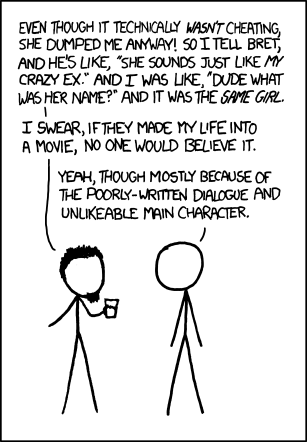
I know. I haven't posted in a long time. I thought about regaling you with all the crazy things that happened in December and January, but then I read this comic.


So, no horror stories today.

(Now, for those who are worried about me, don't be. Nothing was terminal or so bad that it hasn't been completely solved by now. Just events in life ganging up on us for awhile.)

It wasn't all bad though. I read some awesome books. I learned the importance of market research. I had a friend hit #2 in her category on Amazon and then signed with an agent. I had a birthday. Plus, I've been asked a few technical questions I need to answer.

I may touch on some of these things in upcoming posts.

It's good to see you all again.

* xkcd is geeky comic that is funny, insightful, and quite often so profound it keeps me pondering for hours and sometimes days. Every once in a while a comic uses strong language, just in case you don't want to see that.
Creative Commons LicenseUnless otherwise noted, all posts on the John Waverly blog by John Waverly are licensed under a Creative Commons Attribution 3.0 Unported License.
* Background image based on Night Sky theme by Ray Creations